


Macadamia Nuts: The New ‘Gold Mine’ of Vietnamese Agriculture
Currently, Vietnam has many advantages for developing its annual macadamia production. Vietnam has also joined free trade agreements with many large import markets. This demonstrates the great potential for macadamia nut exports in Vietnam. This article will provide an overview of the macadamia nut export situation in Vietnam, as well as the opportunities and challenges. It will also present solutions to optimize the export situation for this nut.

Overview of Macadamia and Its Production in Vietnam
Origin and Nutritional Profile of Macadamia Nuts
Macadamia is a valuable nut originating from northeastern Australia. This nut is notable for its high content of unsaturated fats, providing abundant energy and essential nutrients such as thiamine, vitamin B6, manganese, iron, magnesium, and phosphorus.
In the context of growing consumer health consciousness, macadamia nuts have become an excellent choice for a nutritious and balanced diet.
Key Macadamia Growing Regions
In Vietnam, macadamia is primarily grown in the Central Highlands (Dak Lak, Lam Dong), the Northwest (Dien Bien, Son La), and some provinces in the North and North Central Coast regions.
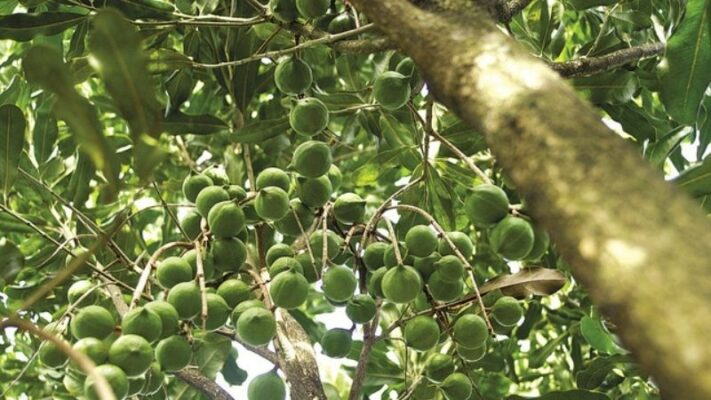
Actual Acreage, Output, Yield, and Development Potential
In 2024, Vietnam’s macadamia cultivation area exceeded 46,200 hectares, mainly concentrated in the Central Highlands and the Northwest, regions with favorable climatic and soil conditions. Lam Dong currently leads the country with a projected output of about 13,700 tons. Many localities have adopted VietGAP and organic standards, resulting in selling prices that are 10–20% higher than traditional farming methods. Intensive farming models are also becoming more common, using techniques such as grafting, water-saving irrigation, balanced fertilization, and integrated pest management, increasing the average yield to 1–1.5 tons of dried nuts per hectare, and even over 3 tons in some specialized cultivation areas. However, the area with quality certification remains limited. Furthermore, according to Nhan Dan Newspaper, there is still significant room for Vietnam to expand its macadamia nut export market share in Japan, South Korea, China, the US, the Netherlands, and Germany.
Vietnam’s Macadamia Nut Export Market
Export Situation in 2024
According to data from the International Trade Centre, Vietnam’s export turnover of macadamia nuts (both in-shell and shelled) reached approximately 17.5 million USD in 2024, an increase of 2.5% compared to 2023. Although this growth is not groundbreaking, it reflects a stable and sustainable trend for the macadamia industry amidst a volatile global economy.
Compared to other major agricultural exports like coffee, cashew, or pepper, the scale of macadamia exports is still modest. However, the potential for market expansion remains immense as global demand for macadamia is steadily increasing, especially in high-end markets such as the US, Europe, and Northeast Asia. The continued growth in turnover shows that Vietnamese macadamia is gradually establishing its position on the global macadamia export map, although it still requires more supportive policies and investment to compete effectively with major producing countries like Australia, South Africa, and Kenya.
Main Export Markets
The United States is currently Vietnam’s largest import market for macadamia nuts. It is also the world’s largest consumer market for macadamia, accounting for nearly half of the global demand. American consumers tend to prefer shelled, pre-packaged macadamia nuts for direct consumption or as an ingredient in the confectionery, chocolate, and macadamia butter industries.
Europe is a potential market due to the trend of healthy food consumption and a preference for nuts with high nutritional value. Countries like Germany, the Netherlands, and France import macadamia nuts for distribution in retail systems, restaurants, and for producing nut milk. However, the technical barriers in the EU are very strict, especially regarding pesticide residue levels, organic certification, and mycotoxin control.
South Korea is emerging as a key Asian market with rapidly increasing demand over the past 5 years. Korean consumers often use macadamia nuts in the pastry, premium snack, and nut milk industries. Compared to the EU and the US, the technical requirements are lower, but food safety certification according to KFDA regulations is still required.
China is a neighboring market and offers logistical advantages for Vietnamese businesses. The demand for macadamia is mainly concentrated in the roasted and salted in-shell segment, which is popular as a common snack. However, China is also a highly competitive market as it both imports and invests in macadamia cultivation in Yunnan and Laos.
The Middle East, including the Gulf countries (UAE, Saudi Arabia, Qatar), is increasingly interested in premium and nutritious foods. Vietnamese macadamia nuts have begun to enter this market through intermediary companies. The Middle East is a potential region but requires strict Halal certification and faces competition from Australian and South African products.
Opportunities and Challenges in Vietnam’s Macadamia Exports
Opportunities
- Strong growth in global demand driven by health trends
According to data from Mordor Intelligence, the global macadamia market is expanding rapidly, projected to reach a value of approximately USD 1.79 billion by 2025, and increase to USD 2.78 billion by 2030, with a compound annual growth rate (CAGR) of 9.2%. This demonstrates the significant appeal of macadamia in the world market, especially from a nutritional and healthy lifestyle perspective.
- Strong development policies from the Vietnamese Government
Vietnam has approved a project for the sustainable development of macadamia trees for the 2021–2030 period, with a vision to 2050. Accordingly, the goal is to achieve an export turnover of 400 million USD by 2030 and increase it to 2.5 billion USD by 2050, with processed macadamia output reaching 130,000 tons by 2030 and 500,000 tons by 2050.
- Favorable natural conditions in Vietnam
The Northwest and Central Highlands regions have climates and soils that are highly suitable for macadamia tree growth, helping to improve input quality and cultivation productivity.
Challenges
- High technical standards from target markets
When targeting markets like the EU and the US, businesses must meet strict requirements for phytosanitary measures, food safety, and organic certification. These are technical barriers that require significant investment.
- Fierce international competition
Countries like Australia, South Africa, and Kenya are major macadamia exporters with professional production ecosystems, forcing Vietnam to strive to improve its production and processing capabilities to compete effectively.
- Economic and international trade volatility
Trends of exchange rate fluctuations, rising logistics costs, and global supply chain disruptions (especially due to geopolitical conflicts and oil prices) increase risks for exporting businesses. This can lead to increased transaction costs and reduced profits.
- Rising trend of trade protectionism
Some markets may apply tariffs, quotas, or trade defense measures to protect their domestic agricultural sectors. This is a constant challenge for internationally competitive agricultural products like macadamia.
Solutions to Promote Vietnam’s Macadamia Nut Exports
- Improving product quality and added value
Businesses and farming households need to standardize cultivation processes according to VietGAP, GlobalGAP, organic, etc., to meet high standards in the US, EU, and Japan. Additionally, developing the deep-processing industry (e.g., roasted and flavored nuts, macadamia oil, macadamia milk, macadamia powder) is crucial to increase value and reduce the risks of relying on raw material exports. Producers also need to invest in post-harvest preservation technology to help extend storage time, and limit spoilage during long-distance transportation.

- Brand development and market promotion
Building a national brand for Vietnamese macadamia, participating in international trade fairs such as SIAL, Anuga, or INC, and strengthening cooperation with major distribution systems in the US, Europe, South Korea, China, and the Middle East. These are essential factors for enhancing recognition and creating a competitive advantage against rivals like Australia or South Africa.
- Supportive policies and public-private partnerships
Finally, the State needs to refine supportive policies and promote public-private partnerships, including preferential credit for raw material and processing zones, a “4-party” linkage mechanism (state, scientists, businesses, and farmers), and agricultural insurance policies, as well as an export stabilization fund to mitigate risks from market and weather fluctuations.
Conclusion
The macadamia nut export situation in Vietnam is at a starting point full of potential. With a small but determinedly expanding cultivation area, along with policy support and global market potential, Vietnamese macadamia can become a high-value agricultural sector, ready to aim for the target of 400 million USD by 2030 and 2.5 billion USD by 2050, according to Decision No. 344/QD-TTg of the Prime Minister: On the approval of the Sustainable Macadamia Development Project for the 2021 – 2030 period, with a vision to 2050.
If you are interested in business cooperation, importing, or distributing Vietnamese macadamia nuts, please contact us today.